

close
Choose Your Site
Global
Social Media
Views: 0 Author: Site Editor Publish Time: 2026-10-20 Origin: Site


Are your current plant containers actively compromising crop root health? Picture this scenario. You are gearing up for a massive spring planting season. Thousands of delicate seedlings and expensive clones await unboxing. If the containers you rely on lack proper drainage or retain excessive solar heat, disaster strikes. You risk losing a significant portion of your inventory to root rot long before plants reach the retail floor. The agricultural market overflows with heavy, expensive, and inefficient options. This makes it notoriously difficult for commercial growers to strike a balance between operational cost and optimal plant health.
To solve this bottleneck, the industry standard for lightweight, scalable, and highly efficient cultivation now relies heavily on Vacuum Formed Round Pots. We will explore exactly what these specialized containers are and the fascinating thermoforming process behind their creation. You will also see how they stack up against other conventional choices and learn the best practices for integrating them into your commercial greenhouse.
Definition: A formed nursery pot is a highly flexible, lightweight plastic receptacle. It is engineered specifically for the transitional growing of plants, seeds, and clones before their final planting.
Manufacturing: These containers are created by heating a specialized plastic sheet. A high-powered vacuum then pulls the material tightly over a custom mold, yielding an incredibly uniform and efficient product.
Cost and Efficiency: They remain significantly more affordable than traditional injection-molded alternatives. This establishes them as the definitive choice for commercial nurseries looking to scale operations without inflating overhead.
Plant Health: Engineered with multi-level drainage systems and opaque, light-blocking interiors via Co-Ex technology. They shield sensitive root systems from moisture buildup and UV damage.
Versatility: Their lightweight, tapered nature makes them effortless to transport. They are highly stackable for warehouse storage and perfect for smoothly transitioning crops into permanent beds.
Recent horticultural market analyses highlight a definitive shift in the industry. Commercial growers are rapidly moving away from rigid, single-use plastics. Driven by rising labor costs and stricter environmental mandates, the market now aggressively favors automation-compatible, sustainable solutions. Nurseries require standardized containers that seamlessly integrate with conveyor systems and automated potting machines. This operational shift perfectly aligns with the adoption of thermoformed solutions that utilize post-consumer recycled materials.
In the commercial sector, plants are rarely cultivated in heavy ceramic or decorative terracotta pots. Instead, growers depend on plastic nursery containers to serve as temporary, highly controlled incubators. These functional vessels are designed from the ground up to prioritize root architecture, moisture retention, and efficient space utilization. By standardizing the root zone environment, nurseries can dial in variables like soil temperature and fertigation distribution. This directly boosts overall crop yield.
The term formed refers directly to the thermoforming process utilized to shape the raw plastic material. Characteristically, these pots possess thin, pliable walls, ribbed structural designs for vertical load-bearing strength, and reinforced rolled rims. Unlike rigid injection-molded containers that can easily snap or crack under sudden pressure, the flexible nature of a formed pot absorbs impact. When a worker grabs a stack of pots with one hand or an automated machine grips the rim, the plastic bends slightly rather than breaking. This resilience makes it highly durable for fast-paced greenhouse environments.
It is vital to draw a hard line between functional nursery containers and aesthetic decorative pots. Formed containers are engineered exclusively for biology. They feature extensive bottom and side drainage systems, optimized soil volume ratios, and materials focused purely on root protection. Conversely, decorative pots prioritize visual appeal but frequently lack proper drainage. They act as a death trap for roots by promoting anaerobic soil conditions. To bridge this functional gap, the industry often employs the cachepot method. The functional nursery pot is simply dropped directly into a decorative outer shell. This ensures the plant receives optimal drainage while satisfying consumer aesthetic demands.
The production journey begins with the careful selection of raw polymers. Manufacturers typically utilize recycled High-Impact Polystyrene or Polypropylene. These plastics strike the perfect balance between flexibility, longevity, and cost-efficiency. Advanced manufacturing facilities employ Co-Extrusion technology. During this initial phase, two separate layers of molten plastic are extruded and pressed together simultaneously. Usually, this consists of a dense black inner layer formulated to block light, paired with a customized outer layer intended to reflect solar heat and provide a clean retail appearance.
Once the continuous plastic sheet is prepared, it feeds into the thermoforming machine. The sheet passes through heating elements until it reaches a precise, highly pliable state. It must be soft enough to mold but stable enough not to tear. The core magic of this process happens in a fraction of a second. The heated sheet is draped over a specialized round mold. Immediately, a high-powered vacuum activates, violently sucking the ambient air out from between the mold and the plastic. This negative pressure forces the pliable plastic to hug the exact contours of the mold. It instantly forms the body of the pot, complete with structural ribs and a sturdy rim.
After the shape is dictated, the plastic must be rapidly cooled to lock in its structural integrity and prevent warping. Industrial cooling fans blast the newly thermoformed containers, dropping their temperature in seconds. Next, automated cutting machinery punches the pots out of the continuous sheet, trimming away the excess webbing. This scrap material is highly sustainable. It is immediately ground up on the factory floor and fed right back into the extrusion hopper. The final, non-negotiable step involves precision punching at the base. High-speed presses punch specific multi-level drainage hole patterns to guarantee optimal water flow in the final product.
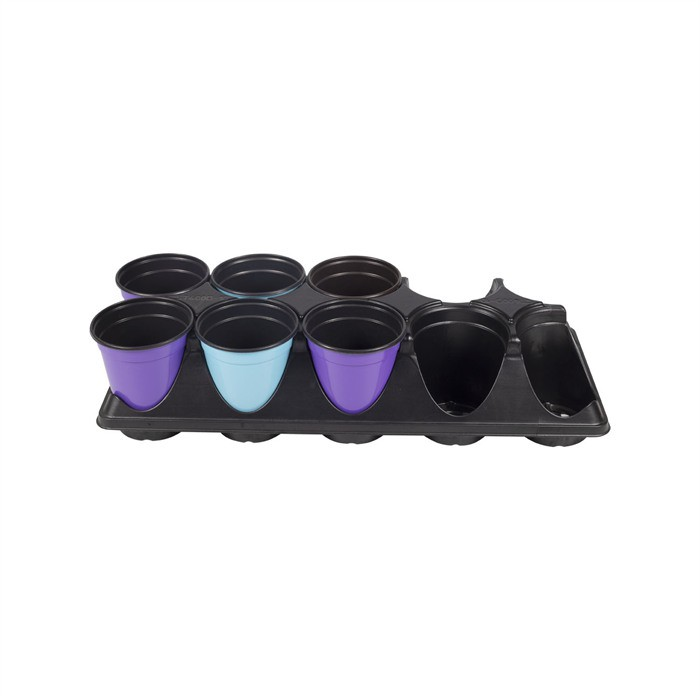
To make a financially sound purchasing decision, commercial buyers must understand how these thermoformed options compare against other standard containers saturating the market.
Injection molded pots are manufactured by injecting liquid, molten plastic into a closed, solid steel mold. This technique results in a significantly thicker, rigid, and heavier container. While they offer extreme durability for long-term use, they require massive amounts of raw material. This makes them expensive to produce. In contrast, thermoformed containers utilize thinner, stretched sheets. This drastically slashes material costs and accelerates production time. Consequently, they stand as the undisputed cost-effective solution for large-scale operations where pots are used transitionally.
Blow molding operates much like inflating a balloon. A heated plastic tube is inflated inside a hollow mold until it expands to take the desired shape. These pots are typically characterized by deep, wide, accordion-like ribs and possess a very sturdy, heavy-duty feel. Blow molded pots are generally reserved for massive applications, such as cultivating mature fruit trees or large landscaping shrubs. However, for standard greenhouse plants, perennials, and smaller shrubs, formed round pots provide more than enough structural integrity without the bloated weight and premium cost of blow molding.
Fabric containers have carved out a niche for their air pruning capabilities. When roots reach the air-exposed fabric edge, they naturally dry out and branch off, preventing harmful root circling. Despite this biological benefit, fabric pots present notable logistical hurdles for commercial nurseries. They lose moisture rapidly, demanding significantly higher irrigation volumes. Furthermore, they are notoriously difficult to scrub and sanitize for reuse. Formed plastics offer superior moisture retention, structural stability for automated conveyor belts, and a substantially lower per-unit cost.
Container Type | Manufacturing Method | Flexibility & Automation | Relative Cost | Best Commercial Use Case |
|---|---|---|---|---|
Vacuum Formed | Heated sheet pulled by vacuum pressure | High flexibility, excellent for automated potting | Low | Standard nursery plants, bulk growing, transitional phases |
Injection Molded | Molten plastic injected into a solid mold | Rigid, can crack under heavy machinery pressure | High | Long-term growth, heavy plants requiring base stability |
Blow Molded | Inflated plastic inside a hollow mold | Moderate flexibility, bulky for storage | Medium | Large trees, heavy shrubs, outdoor long-term holding |
Fabric Pots | Woven or non-woven breathable textiles | Very high flexibility, poor for automation | Medium | Specialty crops requiring intense root aeration |
For wholesale buyers and commercial nursery managers, profit margins are inextricably tied to operational material costs. Thermoforming operates at high speeds. Manufacturers can produce thousands of units per hour. This rapid yield, coupled with the efficient integration of recycled materials, drastically drives down the per-unit cost. By opting for these lightweight nursery containers, growers free up capital. You can then allocate those funds toward premium soil matrices, automated machinery, and elite plant genetics, maximizing your overall return on investment.
Warehouse real estate and shipping logistics represent massive hidden expenses in horticulture. Formed pots are engineered with a highly specific tapered round geometry. This subtle angle allows thousands of empty pots to be nested and stacked tightly together without sticking. A single shipping pallet can accommodate a staggering quantity of these containers. This significantly shrinks freight costs and minimizes the physical footprint required in your storage facilities or greenhouse staging areas.
Root rot, frequently induced by poor drainage, remains one of the leading culprits of crop loss. To combat this, modern containers are outfitted with multi-level drainage holes. These are often punched both on the flat bottom and slightly elevated along the side ridges of the base. This guarantees that even if the pot sits on an uneven, muddy field, water can escape laterally. Direct sunlight exposure can scorch and stunt delicate root systems. The opaque nature of the plastic acts as a shield against harmful UV rays, making light-blocking materials a non-negotiable feature for robust plant health.
Transplant shock is a grower's worst nightmare. It often occurs when a root ball is aggressively disturbed or torn during repotting. Rigid containers frequently force workers to violently tap, shake, or even cut the plastic to extract a stubborn plant. The pliable walls of a formed container eliminate this struggle. Workers can gently massage and squeeze the sides of the pot to loosen the compacted soil. This allows the intact root ball to slide out smoothly, preserving the delicate microscopic root hairs and ensuring a seamless transition into a larger vessel or the ground.
In today's environmentally conscious market, the ecological footprint of agricultural supplies is under intense scrutiny. Historically, petroleum-based containers were viewed as a necessary evil. However, the lifecycle of contemporary nursery containers has evolved dramatically. Today, the polymers utilized in thermoforming are meticulously selected to balance rugged operational durability with environmental responsibility.
The thermoforming industry operates largely on a closed-loop system during production. When the plastic sheets are stretched and the individual pots are punched out, the leftover webbing is immediately ground down. It is melted and fed back into the extruder, ensuring near-zero material waste on the factory floor. For the end user, these pots offer multiple lifecycles. Their resilient nature means they can be washed, sterilized, and reused across several growing seasons. By relying heavily on post-consumer recycled plastics, manufacturers significantly slash the carbon footprint associated with virgin plastic production.
To truly grasp the pinnacle of modern nursery container engineering, one must look at Co-Extrusion technology. Standard plastic pots are typically a single, monolithic layer of uniform color. Co-Extrusion, however, involves extruding two distinct layers of polymer simultaneously. They fuse into a single, highly functional sheet before the vacuum forming even begins.
This dual-layer construction serves a vital biological purpose. The inner layer is manufactured using a dense, dark material, usually black, which completely blocks harmful ultraviolet light from penetrating the root zone. Plant roots are naturally photophobic. Exposure to light can severely stunt their development. Simultaneously, the outer layer is customized in lighter, reflective colors like terracotta, green, or bright white. This exterior reflects solar radiation, preventing the root zone from baking during peak summer heat. For nurseries looking to optimize environmental controls, investing in high-quality round Co-Ex pots engineered with this dual-layer technology is a proven strategy.
One of the most frequent sources of confusion in the horticultural supply chain is the archaic sizing terminology used for plant containers. If you purchase a 1-gallon nursery pot, you will quickly discover it does not actually hold one standard liquid gallon of soil. The industry relies on a historical measurement known as the Trade Gallon. This is approximately 0.71 liquid gallons, or about 2.7 liters. Understanding how top-diameter inches correlate with trade sizes is essential for accurately calculating your bulk soil orders and fertigation dosing.
Selecting the correct container dimensions dictates the physical development of the root system. You must match the pot to the plant's natural growth habit.
Shallow Root Systems: Plants with fibrous root networks, such as ground covers, sedums, and certain vegetables, thrive in wider, shallower pots. These dimensions prevent stagnant moisture from accumulating deep at the bottom of the container, mitigating the risk of anaerobic rot.
Deep Root Systems: Taproot trees and large tropicals demand deeper containers. A deep, tapered pot encourages aggressive downward root migration. This establishes a robust foundation that will anchor the plant securely once transplanted into a permanent landscape.
When procuring containers for a massive commercial greenhouse, minor structural details translate into major operational efficiencies. Follow these engineering guidelines:
First, examine the rim design. A reinforced, flanged rim provides the necessary structural lip for automated potting machines. Mechanical grippers need this lip to lift and transport the containers without crushing the side walls. Second, verify the drainage hole configuration. Look for dual-drainage systems that allow water to escape laterally if the pot is placed on a flat concrete floor. Finally, always confirm that the plastics contain UV-resistant additives. This prevents the material from becoming brittle and shattering mid-season under intense sun exposure.
The physical properties of plastic fundamentally alter how water and air interact with your growing medium. Unlike unglazed terracotta, which breathes and allows moisture to evaporate through its porous walls, plastic is entirely impermeable. While this is fantastic for reducing your watering frequency, it means that all gas exchange and drainage must occur exclusively through the top surface and the bottom holes.
To compensate, it is imperative to formulate a highly aerated, well-draining soil mix. Incorporating coarse aggregates like perlite, pumice, or composted pine bark creates macropores within the substrate. Hearing the satisfying crunch of perlite as you mix your soil is a good indicator. It means excess water will drain rapidly, pulling fresh oxygen down into the root zone.
Because these containers serve as transitional homes, monitoring plant development is a critical horticultural skill. Leaving a plant in its container for too long results in a root-bound condition. Roots tightly circle the inner walls, eventually strangling the plant. Clear indicators include thick roots actively protruding from the bottom drainage holes. Another sign is irrigation water running straight through the pot instantly because the root mass has entirely displaced the soil. When these signs manifest, simply squeeze the flexible walls to release the plant and upgrade it to a container one or two trade sizes larger.
Maximizing the return on investment for your nursery supplies means treating your containers as reusable assets rather than disposable trash. However, reusing unwashed pots is the fastest way to transmit soil-borne pathogens, fungal spores, and overwintering pests between crop cycles. To safely reuse your inventory, start by mechanically brushing out all residual organic matter and scrubbing away white salt buildup from fertilizers. Next, submerge the containers in a sanitizing solution, typically one part household bleach to nine parts water, for at least 15 minutes. Rinse them thoroughly with clean water to strip away any chemical residue. Allow them to air dry completely in the sun before introducing fresh soil and new seedlings.
Understanding the engineering and functionality behind formed nursery pots demystifies why they remain the absolute backbone of the commercial horticultural industry. These specialized receptacles strike the perfect balance. They provide exceptional durability and root health while remaining highly budget-friendly for any scale of growing operation. By leveraging advanced manufacturing techniques, particularly dual-layer Co-Extrusion, modern containers offer premium UV protection, temperature regulation, and structural flexibility.
Whether you are managing a multi-acre commercial nursery or refining a high-yield home greenhouse setup, upgrading your container inventory is a high-leverage improvement. Ready to scale your operations with sustainable, reliable materials? Explore the full range of high-quality wholesale nursery pots from HJ Pots to find the exact specifications that match your crop requirements. Safeguard your bottom line and give your plants the perfect start today at HJ Pots.
There is virtually no functional difference. Vacuum forming is simply a highly specific sub-category of the broader thermoforming process. In this method, a heated, pliable plastic sheet is draped over a mold, and a high-pressure vacuum is applied to forcefully pull the material tightly against the shape, creating the final, uniform container.
Yes, the vast majority of these containers are manufactured from universally recyclable polymers, primarily Polypropylene and Polystyrene. You should always check the resin identification code stamped on the bottom of the container to ensure it aligns with your local municipal or commercial recycling guidelines.
These containers are intentionally engineered to be thin so they remain lightweight, flexible, and highly cost-effective for bulk manufacturing. The flexible walls serve a highly practical purpose in the greenhouse. They allow growers to gently squeeze the sides to easily extract the root ball without causing transplant shock or mechanical damage.
Absolutely, these containers are heavily utilized in outdoor commercial growing environments and open-field nurseries. High-quality variants are formulated with specific UV-resistant additives during the extrusion process. This ensures the plastic will not quickly become brittle, crack, or degrade when exposed to harsh, direct sunlight over a long season.
Yes, they are explicitly designed to promote optimal root health through precision-punched drainage systems. Most feature multi-level drainage holes and raised bottom ridges that prevent water from pooling. This ensures excess moisture flows freely away from the root zone to prevent anaerobic conditions and root rot.
Co-Ex is an abbreviation for co-extruded. It is an advanced manufacturing technique where two distinct layers of plastic are fused together simultaneously. This typically results in a pot with a dark inner layer to block harmful UV light from delicate roots, paired with a lighter, colored outer layer to reflect solar heat and maintain cooler soil temperatures.
When handled properly and kept out of extreme, prolonged freezing conditions, a high-quality formed pot can easily last for 2 to 3 growing seasons. Their lifespan depends heavily on the presence of UV inhibitors in the plastic and the sanitation methods used between crop cycles.
Yes, provided you select models engineered with reinforced, rolled rims. The automated grippers on potting machines and conveyor lines rely on this sturdy upper lip to lift, fill, and move the containers without crushing the thinner side walls. Always verify rim specifications with your supplier if automation is a priority.


